
Should you Invest in Stocks?
Date Written by The Wise Wallet
You’ve accumulated some spare cash amidst the dreadful taxation, living expenses and other financial black holes, you may think you can finally save something. And, well yes you can essentially, but is this truly the best course of action?
Let us look at this with an example to paint a better perspective.
Imagine you’ve diligently grafted hard this month with your 9am to 5pm daily job and
have managed to spare an extra £500 after covering all your expenses. You’ve already indulged in a treat or two, so this £500 has now found its way into your savings account.
The interest rate of this savings account you stashed your £500 is an impressive 0.1%….. In 5 years, this will give you £502.51, thanks to a little something called compound interest, which we will look in-depth real soon. But back to the £502.51, it looks like you’ve made money by simply leaving your saved money into a saving account. Though one can argue whether £2.51 should be truly considered as making money over 5 years….
Now the issue here is we have missed out one key factor. Yes, the dreaded slayer of all old notes and coins…. INFLATION!!
Simply put, inflation makes your current cash or money less valuable as time progress. So, the same £1 you used to by chips today, in 3 years’ time will not be enough to buy those same chips. It’s a bit of a backward thinking perspective. Because everything has gone up in prize, the £1 is now less valuable in getting what you want compared to the past.
Back to our scenario, thanks to inflation, by simply leaving the £500 in a savings account over 5 years, its value will undoubtedly fall. Now inflation rate per year can vary but let’s give it a rough 3% for this scenario.
(it’s important to know inflation isn’t fixed, and thanks to Brexit, Covid-19 and other factor, in UK we are in unfortunate times and have experienced some horrible inflation rate, for example in May 2022 we have suffered roughly an inflation of 9%, one of the worst cases for decades).
This means that for the £500, in 5 years it will need to be £580.81 to have achieve the same purchasing value. Now I don’t know about you but the £502.51 is looking less impressive. Unfortunately, the interest rates offered by saving account typically can’t counteract inflation, hence overall resulting in a net loss in the value of your savings.
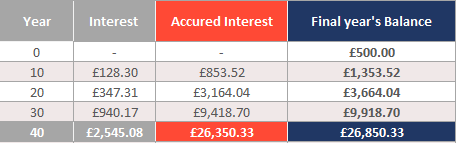
What we see here is compound interest. A phenomenon where we obtain interest not only on the original investment, but also on the accumulated interest. Getting interest of interest to put it plainly. What’s amazing is how leaving this £500 to work for itself can transform into a staggering £26,850.33.
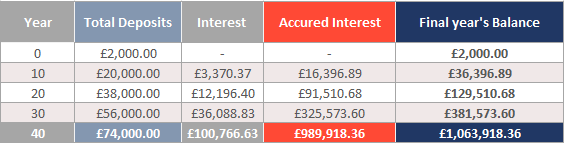
But let’s look at an even more interesting scenario: imagine if you were to initially invest £2000 and then £150 monthly for 40 years. The result you might ask. Well, it’s a jaw-dropping £1,063,918.36. Yes, you read that correctly – you’d be a millionaire, without actually working. This, my friends, is the magic of compound interest.
This table below just puts this financial wizardry into perspective.
You can also use this formula below or any of the compound interest calculators online to quickly find out how much you can make.
You can also use this formula below or any of the compound interest calculators online to quickly find out how much you can make.

A is the future value of the investment including interest.
P is the principal investment amount (the initial investment).
r is the annual interest rate (in decimal).
n is the number of times that interest is compounded per year.
t is the time the money is invested for, in years.
Of course, if we factor in inflation, let’s say at £3%, the 10% return essentially dwindles to 7% return. But even then, you can get the picture that you’ll be making some really good passive income if you start early and have patience.
So, you should start investing straight away, right? Well, yes and no. You should start investing but not straight away. Putting all your spare money into investment leaves you in a vulnerable state. One thing I have yet to highlight is investments does include its fair share of risk IF done incorrectly. You could lose money. That’s why the form of investment we recommend for novices is crucial to adopt and this form is the long-term approach. Here, short-term fluctuations are common, but they often stabilise and fix itself over time.
Also, in case of an unforeseen events in your life that requires money, you don’t want to tap into your investments as it can affect your returns and it may not be readily available. You may urgently need that money from your investment pool but at the time your stocks/assets to which you invested in may be suffering from temporary decline.
Hence, it’s common for those who invest to establish some form of initial savings that doesn’t generate money, but acts as a financial backup, for when time gets rough. Three months of salary should be enough of a cash cushion to start with but if you can increase this up 6 months in a short period, then why not.
Another perspective you can use with your money, once you got your savings sorted, is any you don’t need in a year should be invested (where it be self-investment, assets and so on). Whereas money you need within a year should stay in the form or readily accessible cash. For example, money in your bank to pay for your yearly car insurance or a holiday you’re planning.
To summarise, investing is a great way to let money work for you and you can see some real big returns over a long period of time. But you should get some form of financial cushion before fully committing your spare change all into investments. Moreover, investing can not only make you gain but also lose money. Hence knowing what to invest in and knowing when a loss of money may only be temporary, can really help you achieve that financial freedom in the distant future.

Welcome
To The Wise Wallet. Here we hope to share our valuable experiences and knowledge so that you too can make your financial dreams a reality.





Latest Posts
Sem integer vitae justo eget magna fermentum iaculis eu non. Eget sit amet tellus cras adipiscing enim eu turpis egestas.